
Board-Level Sales Guidance: Your Strategic Growth Governance for 2026, and Beyond…

Robust Board-Level sales guidance becomes your most valuable boardroom asset.
When Robust Board-Level Sales Guidance Becomes Your Most Valuable Boardroom Asset.
Why does the gap between boardroom strategy and frontline sales execution often feel like an unbridgeable chasm? You've likely sat through many meetings where inaccurate forecasts and 'gut feel' pipeline updates have left you questioning the true health of your revenue stream. It's a common tension that keeps many Australian directors awake at night. This is precisely where robust Board-Level sales guidance becomes your most valuable asset.
It isn't about micromanaging the sales manager; it's about governing the alignment between your strategic intent and the modern buyer journey.
We understand that you want to see sustainable and predictable sales performance that justifies investor confidence.
You'll learn how to master the art of board-level sales oversight to bridge the gap between high-level strategy and frontline revenue execution. This article provides a strategic governance framework for 2026 that replaces vague reporting with actionable visibility. We'll explore how to foster a culture of accountability that turns your sales pipeline into a reliable engine for growth, ensuring your tactics finally align with your overarching business objectives.
Key Takeaways
Differentiate between operational micromanagement and strategic governance to effectively bridge the execution gap between the boardroom and the customer.
Implement evidence-based Board-Level sales guidance to replace unreliable "gut feel" forecasts with high-integrity, data-driven pipeline oversight.
Utilise the Modern Selling Framework to pivot your organisation from outdated "push" sales tactics to a more effective, customer-led "pull" engagement model.
Master a framework of critical questions for monthly reviews that maintain high-level accountability while respecting the boundaries of management execution.
Strengthen stakeholder and investor confidence by ensuring your company’s long-term value proposition is consistently reflected in every frontline sales interaction.
The Strategic Imperative of Board-Level Sales Guidance
Sales is frequently the most expensive line item on an Australian company's profit and loss statement. Yet, for many directors, it remains a 'black box' that is difficult to decipher.
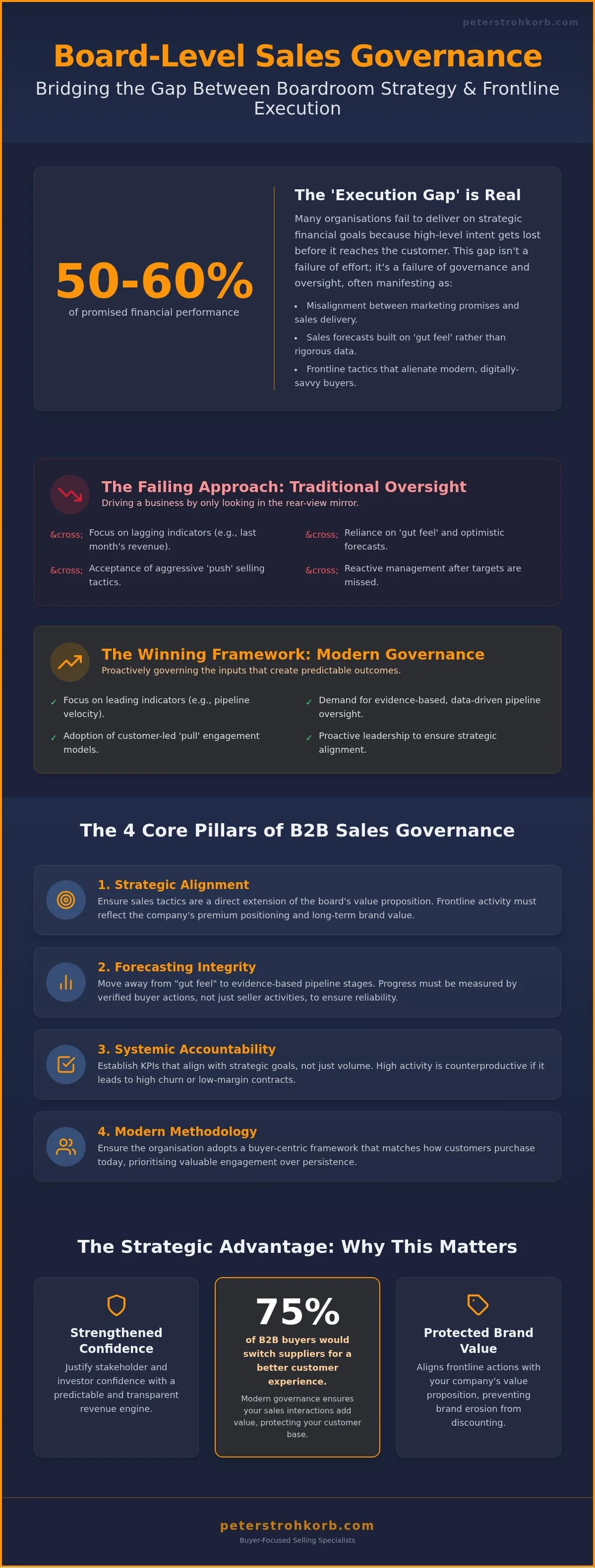
Effective Board-Level sales guidance isn't about looking over the shoulder of the sales manager. It's a strategic governance function designed to ensure that the company's high-level vision actually reaches the customer. Some industry reports suggest that many organisations only deliver 50-60% of their promised financial performance. This often happens because strategic intent gets lost before it hits the frontline.
This 'Execution Gap' isn't a failure of effort; it's a failure of oversight, often manifesting as:
Misalignment between marketing promises and sales delivery.
Sales forecasts built on 'gut feel' rather than rigorous data.
Frontline sales tactics that alienate modern buyers.
When sales forecasts are built on hope rather than rigorous data, shareholder value is at risk. Directors who rely on optimism as a strategy are leaving the business's future to chance. By treating sales as a core pillar of a robust Corporate Governance Framework, boards can move beyond reactive management and into proactive leadership.
Why Traditional Sales Oversight is Failing Boards
Traditional oversight often focuses on lagging indicators like last month's revenue. This is like driving a car while only looking in the rear-view mirror. It tells you where you've been, but nothing about the road ahead. Legacy tactics, such as aggressive 'push' selling, now create significant friction with modern B2B buyers. Research indicates that 75% of B2B buyers would switch suppliers for a better customer experience. If your sales team is still using outdated methods, they're likely alienating the very prospects your marketing team is working hard to attract. Misalignment between marketing promises and sales delivery costs more than just money; it costs reputation.
Sales as a Fiduciary Responsibility
Directors have a fiduciary responsibility to understand the health of the revenue engine. It's about business longevity.
Identifying pipeline fragility before it impacts the balance sheet is essential risk mitigation. A board's role is to foster a buyer-centric corporate culture, ensuring that every sales interaction adds value rather than just seeking a signature. This level of Board-Level sales guidance ensures that the sales function is an asset to be governed, not just a cost to be managed. It creates a systematic approach to protecting and growing the company's most vital asset: its future revenue.
Core Pillars of Sales Governance for B2B Boards
High-performing boards recognise that revenue is not a random byproduct of activity. It is the result of a deliberate, governed process. Effective Board-Level sales guidance requires a shift from simply observing outcomes to governing the inputs that create them. By implementing a strategic framework for sales governance, directors can ensure that the sales function is both predictable and sustainable. This involves four essential pillars:
Strategic Alignment: Sales tactics must be a direct extension of the board's value proposition. If the strategy focuses on premium positioning but the sales team relies on heavy discounting, the brand's long-term value is being eroded.
Forecasting Integrity: Move away from "gut feel" qualification. Boards should demand evidence-based stages where progress is measured by verified buyer actions, not just seller activities.
Systemic Accountability: KPIs must align with strategic goals rather than just volume. High-volume activity is counterproductive if it leads to high churn or low-margin contracts.
Modern Methodology: The board should ensure the organisation adopts frameworks that match how buyers actually purchase today, prioritising engagement over persistence.
Leading vs. Lagging Indicators in the Boardroom
Revenue booked is the ultimate lagging indicator. By the time it appears on the balance sheet, the opportunity to influence the outcome has passed.
Directors should instead look at leading indicators like pipeline velocity and prospect engagement quality. These metrics offer a window into future performance. Research shows that 75% of B2B buyers would switch suppliers for a better customer experience; therefore, measuring the buyer experience is a more accurate predictor of growth than any historical spreadsheet. Seeking specialised revenue growth advice can help boards define these indicators more clearly.
Risk Mitigation of Sales Strategy
Governance involves identifying the "Pipedream" early. This means spotting over-optimistic forecasts before they become financial misses. Boards must also address single-point-of-failure risks, such as when a significant portion of revenue relies on a handful of key accounts without a broader strategy. Finally, the board must govern sales ethics. In an era of instant digital feedback, aggressive or misleading outreach can damage a brand's reputation in minutes, taking years of hard work to repair. Robust Board-Level sales guidance ensures that the sales team protects the company's reputation as much as its revenue.
The Modern Selling Framework: A New Standard for Boards
The Modern Selling Framework is not merely a collection of sales techniques; it is a systematic governance model designed for the 2026 business environment. Many Australian boards still oversee sales departments that operate on legacy principles of volume and persistence. This disconnect creates a significant risk to revenue stability. By integrating sales governance into the standard meeting agenda, directors can ensure that the revenue engine is built on modern, buyer-centric principles rather than outdated 'push' tactics.
Transitioning from a 'push' model to a 'pull' engagement strategy is a strategic shift that requires Board-Level sales guidance. Traditional selling often relies on aggressive outreach that creates friction with prospects. In contrast, the Modern Selling Framework focuses on building authority and trust, drawing the buyer toward the solution. This transition is underpinned by the total alignment of sales and marketing. When these two functions operate in silos, the resulting 'Execution Gap' erodes margins and increases the cost of customer acquisition. A unified revenue team is the only way to ensure a consistent brand message reaches the market.
Aligning with the Modern Buyer Journey
The way Australians buy B2B services has changed fundamentally. Current research indicates that buyers may complete between 70% and 90% of their research independently before they ever engage with a salesperson. If your board is still measuring success based on the number of 'cold calls' made, you are governing a ghost ship. The Modern Selling Framework optimises for this digital-first reality by ensuring that the company’s expertise is visible and valuable long before the first meeting. Directors must play a role in approving this shift, moving resources away from high-volume, low-yield activities toward high-value prospect engagement and outreach advisory.
Legacy vs. Modern Selling: A Boardroom Comparison
To provide effective Board-Level sales guidance, directors must recognise the stark differences between legacy operations and modern revenue teams. Legacy models are typically volume-based and product-centric, often resulting in short-term revenue spikes followed by long periods of stagnation. Modern models are value-based and integrated, prioritising the buyer's needs over the seller's quota.
Legacy: High-pressure tactics, siloed marketing, and a focus on 'closing' the deal.
Modern: Consultative engagement, integrated revenue teams, and a focus on solving buyer challenges.
The ROI of modernising the sales force is found in sustainable results. By adopting a buyer-centric approach, businesses can achieve more predictable growth and higher customer lifetime value, directly impacting the long-term health of the company’s balance sheet.
Board-Level Sales Guidance for Business Growth
Implementing Sales Oversight, Without Micromanagement
The line between strategic governance and operational interference is often blurred in the boardroom. To provide effective Board-Level sales guidance, directors must focus on the 'what' and the 'why' rather than the 'how'. While management is responsible for the daily execution of sales activities, the board's role is to ensure those activities align with the company's long-term risk appetite and growth objectives.
Establishing a dedicated Revenue Committee or appointing a specialist through Peter's Board Directorship Services can provide the necessary expertise to maintain this balance without overstepping into management territory.
Adopting the Modern Selling Framework creates a common language between directors and sales leaders. Instead of debating individual deals, the conversation shifts to the health of the system. Directors should use a 'Critical Questions' framework during monthly reviews to probe for systemic issues. Rather than asking why a specific deal hasn't closed, ask: "What buyer-verified evidence supports our current pipeline velocity?" or "How does our current outreach strategy protect our brand reputation?" These questions demand data-driven answers and discourage anecdotal reporting.
The Board-Ready Sales Dashboard
Standard CRM reports are often too granular for effective governance. A board-ready dashboard should focus on strategic insights that signal the future health of the business. Crucial metrics include conversion velocity, customer acquisition cost (CAC), and pipeline health by lead source. By visualising these trends, boards can spot 'cracks' in the revenue engine, such as a rising CAC or a slowing velocity, long before they manifest as financial craters on the balance sheet. This level of visibility allows for proactive adjustments to the strategy rather than reactive cost-cutting after a missed quarter.
Fostering Strategic Sales Leadership
A high-performance sales culture starts with leaders who understand both the market and the boardroom. Providing sales coaching for executives ensures that your sales leadership can translate frontline data into strategic narratives that the board can act upon. This support helps the CEO manage the tension between short-term targets and long-term sustainability. Crucially, the board must ensure the leadership team has the resources and authority to fully implement the Modern Selling Framework. When leadership is empowered with a validated methodology, the entire organisation moves from a culture of 'busy-ness' to a culture of predictable, governed results.
The Peter Strohkorb Advantage: Professional Boardroom Guidance
Many Australian boards recognise the need for a shift in sales governance but lack the internal expertise to drive such a fundamental change. Peter Strohkorb Sales Advisory fills this critical gap by providing high-level B2B revenue strategy that bridges the divide between strategic intent and frontline execution.
By engaging Peter’s Board Directorship Services, organisations gain a seasoned expert who understands the nuances of the modern buyer journey. This isn't about traditional sales consultancy; it's about providing the strategic oversight necessary to ensure the revenue engine is both efficient and ethical.
The unique value of Peter's approach lies in the blend of strategic advisory and executive sales coaching. He doesn't just offer advice from a distance. He works closely with the board and leadership team to implement the Modern Selling Framework.
This ensures that the Board-Level sales guidance provided is actually translated into tangible outcomes. By fostering boardroom-ready sales leaders, Peter helps organisations build a culture of systemic accountability. This methodical approach reduces the risk of missed financial targets and significantly improves stakeholder confidence across the board.
Strategic Revenue Growth Advice for Australian Boards
Australian SMEs and B2B firms often face complex market shifts that require more than just tactical adjustments.
Peter provides tailored Peter's Revenue Growth Advice that looks well beyond the next quarter. An independent perspective is vital for identifying blind spots in current sales performance that internal teams might overlook. While management is often too close to daily operations to see systemic flaws, an external advisor brings a validated, objective methodology to the table. The focus remains on sustainable, long-term revenue expansion, ensuring that growth is a permanent feature of your business model rather than a temporary spike.
Next Steps: Securing Your Revenue Future
The path to better sales governance begins with a clear understanding of your current state. Peter helps boards implement the Modern Selling Framework through a structured process, often starting with a comprehensive sales governance audit. This audit identifies exactly where strategic intent is being lost and where alignment between sales and marketing can be strengthened. By securing professional Board-Level sales guidance, you protect your company's most vital asset: its future revenue.
Ready to transform your sales oversight and bridge the execution gap?
You can Enquire about Board-Level Sales Guidance with Peter Strohkorb today to begin the journey toward predictable and sustainable growth.
Securing Future Revenue Through Strategic Sales Governance
The transition to a sophisticated revenue model requires more than just new software or a revised commission structure. It demands a fundamental shift in how directors view their role in sales oversight. By focusing on systemic alignment and buyer-centric data, you can replace the anxiety of unpredictable forecasts with the confidence of governed growth. Effective Board-Level sales guidance ensures that your strategic vision isn't lost in translation but is consistently delivered in every customer interaction. This framework protects your brand reputation while building a resilient revenue engine that can withstand market shifts.
As a specialist in the Modern Selling Framework and an expert B2B revenue growth advisor, Peter Strohkorb brings over a decade of specialised advisory experience to Australian boards. He provides the independent perspective needed to identify hidden risks and unlock sustainable expansion. Don't leave your 2026 financial targets to chance or "gut feel" reporting. It's time to bridge the execution gap and foster a culture of high-integrity sales performance.
Book a Strategic Consultation with Peter Strohkorb to begin fortifying your boardroom governance today. Your path to more predictable and sustainable sales results is just a conversation away.
Frequently Asked Questions
What is the difference between sales management and board-level sales guidance?
Sales management focuses on the daily "how" of execution, while Board-Level sales guidance addresses the strategic "what" and "why" of revenue generation. Management looks at individual rep performance and activity quotas. In contrast, the board governs the alignment between the company's long-term value proposition and the market's current buying behaviour. This distinction ensures directors maintain oversight without slipping into operational micromanagement.
How can a board identify whether their sales strategy is misaligned with the market?
Misalignment often manifests as a rising cost of customer acquisition (CAC) or a significant drop in pipeline velocity. If your marketing team is generating interest that the sales team cannot convert, or if prospects are dropping out late in the cycle, your strategy is likely out of step with the modern buyer. Boards should watch for these trends as early warning signs that the current sales methodology no longer matches how the market wants to buy.
What are the most critical sales KPIs a board should monitor in 2026, and beyond…?
In 2026, boards should prioritise leading indicators like pipeline velocity and prospect engagement quality over lagging revenue figures.
Specifically, you should monitor the percentage of deals moving through buyer-verified milestones rather than just seller-reported stages. Tracking the cost of selling as a percentage of total revenue also provides a clear view of the efficiency of your sales engine and its impact on the balance sheet.
Why is Sales and Marketing alignment a governance issue, rather than a departmental one?
Misalignment between sales and marketing is a governance issue because it represents a systemic failure to protect shareholder value. When these departments operate in silos, they waste capital on ineffective lead generation and damage the brand's reputation through inconsistent messaging. The board must ensure these teams act as a single revenue engine to maximise operational efficiency and deliver a seamless experience to the customer.
How does the Modern Selling Framework improve forecasting accuracy for boards?
The Modern Selling Framework improves forecasting by replacing subjective "gut feel" with objective, evidence-based buyer actions. Instead of relying on a salesperson's optimism, Board-Level sales guidance under this framework requires proof of prospect engagement at every stage. This systematic approach reduces the risk of over-optimistic "pipedreams" and provides the board with a much more reliable view of future financial performance.
When should a board consider appointing a specialist sales advisor or fractional director?
A board should consider appointing a specialist advisor when the organisation consistently misses its revenue targets or lacks a predictable sales pipeline. If the current directors don't have deep expertise in modern B2B sales governance, bringing in a fractional director can provide the necessary oversight. This independent perspective is particularly valuable during market shifts or when the company needs to transition from legacy tactics to a more modern approach.
Can board-level guidance help fix a culture of low sales performance?
Board-level guidance can fix low performance by establishing a culture of systemic accountability and clear strategic expectations. By implementing a validated governance framework, the board signals that sales results are a matter of process, not just luck. This top-down approach provides the structure and resources leadership needs to transition from a culture of "busy-ness" to one of high-value, results-oriented engagement.
How does modern B2B prospect engagement differ from traditional outreach?
Modern B2B prospect engagement is a "pull" strategy focused on building authority and trust, whereas traditional outreach is a "push" strategy based on volume and persistence. Research shows that buyers now complete up to 90% of their research independently. Modern engagement respects this by providing value long before the first meeting. It moves away from cold calls and hard sells in favour of acting as a trusted advisor to the buyer.

Book a complimentary advisory call with Peter Strohkorb